Design Guide
Tabby (Uncommon)
Category: Mutations
Genetics: Ty_
Locus: B | Ty | Cv | Dt | D
BTy = Bengal, TyCv = Tabby, TyDt = Tabby, TyD = Dun Tabby, nTty/TyTy = Tabby
Overview:
- Causes swirl/stripe markings that mirror the appearance of classic tabby cats, causing a combination of swirls around 1-3 origin points on the body and stripes that follow the flow/shape of the body.
- Stripes should generally be oriented horizontally on most of the body, but may become more vertical in the neck/withers area.
- Markings are always darker than what's below them, but can be lowered in opacity as to be affected by natural variance.
- Where they cross the undersides or at the edge of partial-body coverage, stripes may optionally be faded by a soft gradient, either to lower their opacity or fade them out completely.
- Ends of the stripes should taper, and width of stripes should vary. Origin point of the swirled markings may be more solid/rounded.
- Face markings are optional on the cheek/jaw and forehead areas, often with the classic M-shaped mark above the eyes like tabby cats.
- Mane/Tail: Neck stripes may continue into the mane if they cross over the crest. Tail may be striped, following the direction of the hair. Both mane and tail stripes may be solid from root to tip or fade out at the ends.
- Skin: No effect
- Eyes: No effect

Interactions:
- Dun Tabby: When Dun and Tabby are present on the same horse, both will co-exist.
- Causes body dilution under the Tabby markings.
- Also causes dorsal stripe and leg barring, but not shoulder barring.
- Dorsal stripe will be on top if darker than Tabby, or underneath if lighter.
- Leg barring should show one or the other on the joint, not overlap.
- Facial cobwebbing from Dun is optional but should not cross/overlap Tabby face markings.
- Only applies to normal Dun, not Primitive Dun.
Range:
- Minimum: Stripes covering at least half of the main part of the body (excludes head/legs). Must have at least one swirl area.
- Maximum: Stripes covering the entire body, except for the head and lower legs.
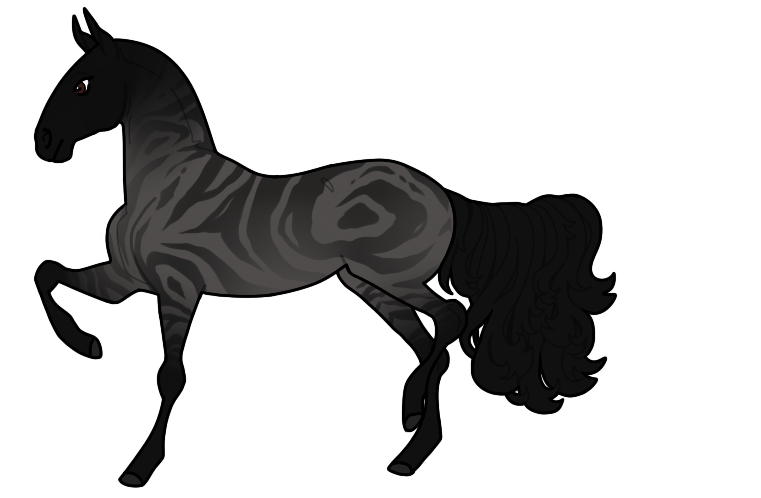
Blue Roan Tabby
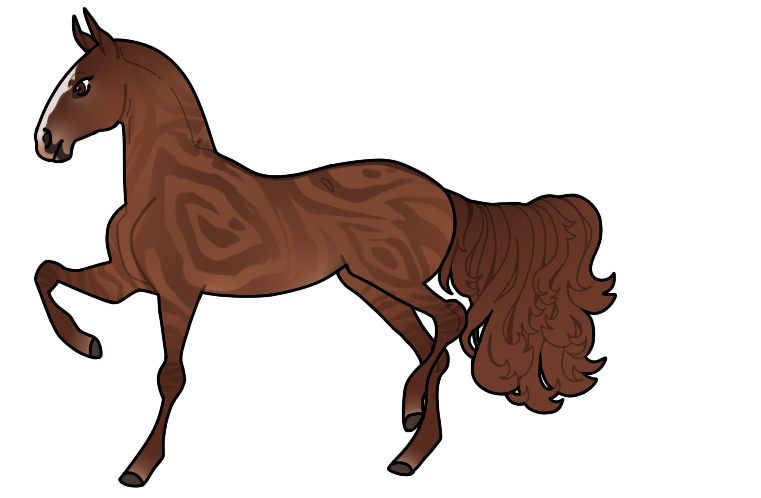
Red Dun Tabby
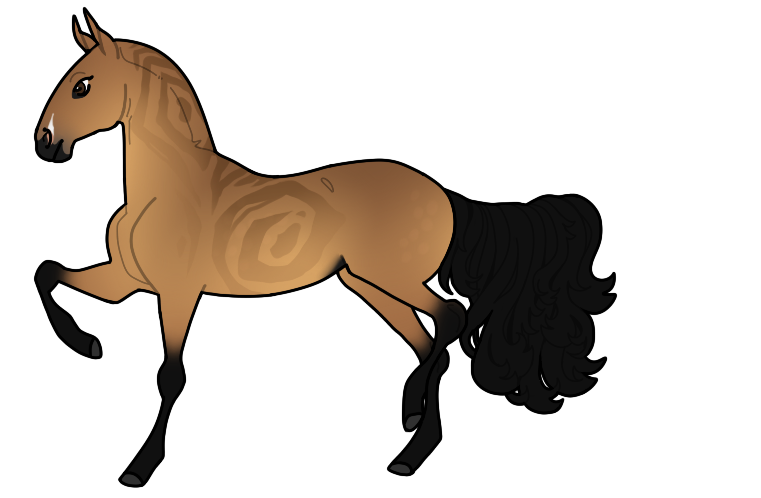
Buckskin Tabby
Civet (Rare)
Category: Mutations
Genetics: Cv_
Locus: B | Ty | Cv | Dt | D
BCv = Bengal, TyCv = Tabby, CvDt = Civet, CvD = Dun Civet, nCv/CvCv = Civet
Overview:
- Civet causes broken/spotted striping that flows horizontally across the body. Stripes should be fairly large and rounded rather than thin and sharp.
- It is at its most random in the center of the barrel, though its striping pattern is much more clearly defined on the hindquarters and chest.
- Overall, even where it is most spotted, Civet should have a relatively linear flow instead of being completely scattered.
- Causes a dorsal stripe that extends from tail to poll, and solid legs up to at least above the knee/hock.
- May optionally cause a dark mask on the face that extends over the eyes. May be a solid mask or cause spotting/striping below the eye.
- Striping/spotting must be darker than what is below it. The edges of a group of stripes may be faded (for example, on the upper neck if extensive coverage, or at the ends of a group of chest stripes).
- Mane/Tail: No effect
- Skin: No effect
- Eyes: No effect
Interactions:
- Dun Civet: When Dun and Civet are present on the same horse, both will co-exist.
- Causes body dilution under the Civet markings.
- Dorsal stripe and leg barring are not visible as Civet is on top.
- Should not have shoulder barring from Dun.
- Only applies to normal Dun, not Primitive Dun.
Range:
- Minimum:
- Solid legs extending just above the knee/hock, horizontal broken striping up to the chest and back of the legs/hindquarters.
- Striping should come at least halfway up to the chest, and at least up to the stomach line in the back.
- Dorsal stripe from tail to poll.
- Maximum:
- Solid legs extending just above the knee/hock, horizontal broken striping up to the chest and back of the legs/hindquarters.
- Further broken striping across the entirety of the barrel, becoming spottier toward the center.
- May travel halfway up the neck before fading off.
- Dark mask covers the top of the head and wraps around the eyes/cheeks.
- Dorsal stripe from tail to poll.
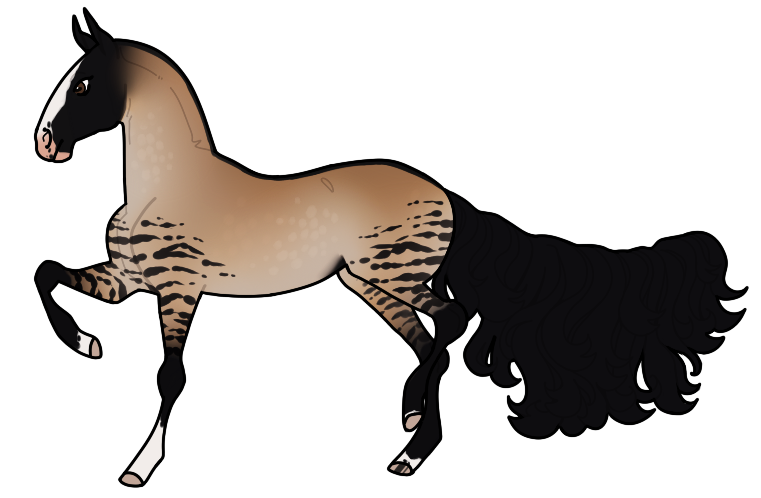 Grey on Buckskin Civet Rapunzel + Masked
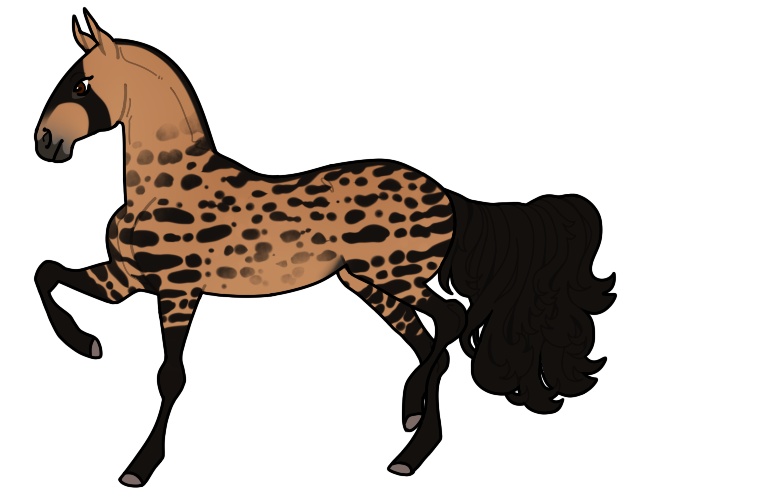 Buckskin Civet
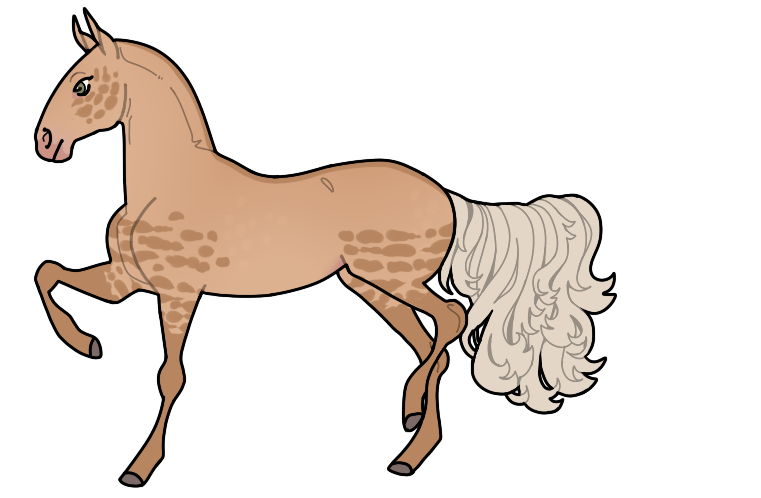 Gold Pearl Civet
Ghoul (Seasonal)
Category: Mutations
Genetics: Gh_
Locus: Gh
Overview:
- White pattern that originates from the head/neck, as if a sheet has been draped over the horse.
- May have ripped/torn holes for the eyes, mouth, and within the pattern. Holes should be tapered.
- Edges will be irregular/frayed, again as if torn or cut at the ends.
Range:
- Minimum: Must cover most of the head, covering up to the eye/jaw vertically. Should have the same tapered edges as usual.
- Maximum: Marking should angle up and taper along the back toward the tail, not reaching the tailhead. Cannot cross the belly, and coverage should taper closer to the topline as it moves toward the back of the horse.
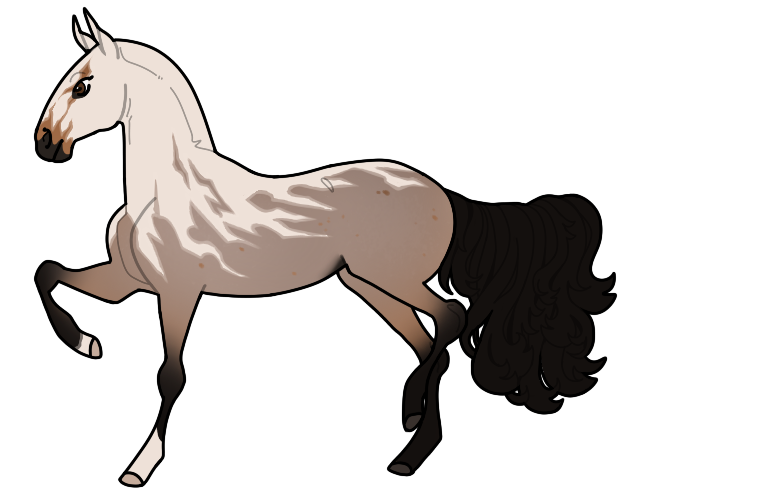
Buckskin Roan Ghoul
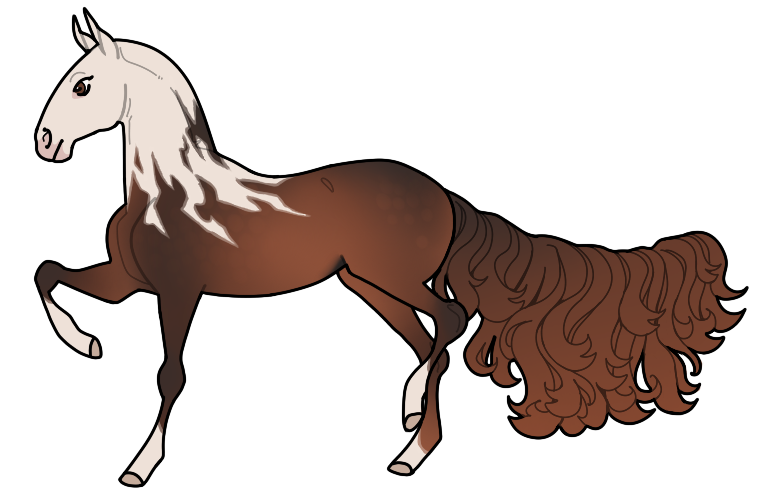
Sooty Chestnut Ghoul Rapunzel
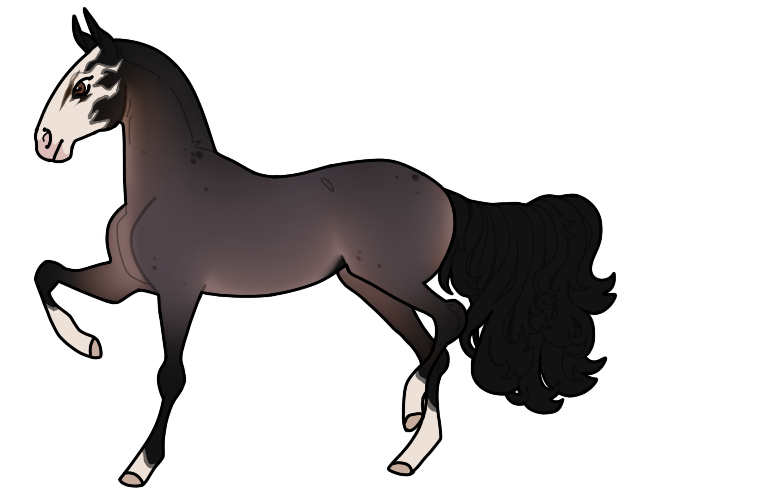
Bay Roan Ghoul
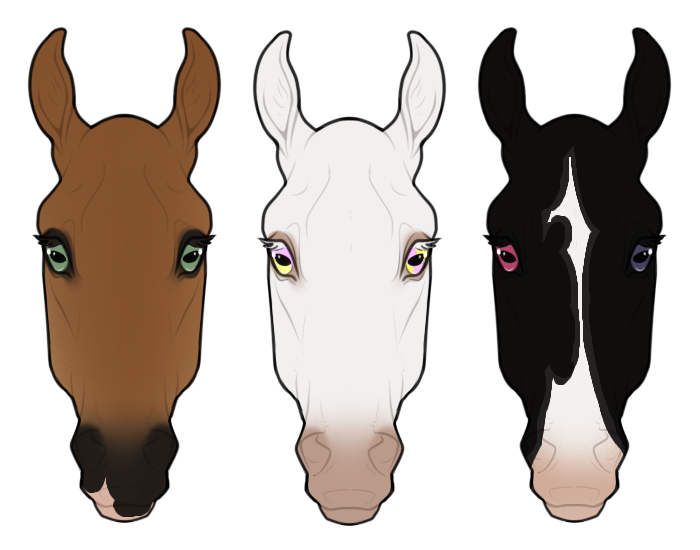
Gemstone (Common)
Category: Oddities
Overview:
- Causes the eyes to be any non-greyscale color. They must have a noticeable hue, and cannot contain more than two colors.
- Bicolored gemstone presents like Heterochromia but doesn't have to be blue; first color goes on as normal, then a second color may fully color an eye and/or cause patches in one or both.
Interactions:
- Rift: When paired with Rift, the eye color must be light/pale, with a typical blind pupil for Rift.
- Reaper: When paired with Reaper, the sclera (eye white) will turn black, while the iris will be affected by Gemstone.
Chimera (Uncommon)
Category: Oddities
Overview:
- Causes patches of another color on the coat, according to the specifications below.
- On foals, Chimera may be anything genetically possible from the parents. In breedings, it is automatically rolled for color.
- On imports, Chimera is based on the main phenotype. You may remove genes found in the base pheno, switch the base color (e/a genes), and add up to 1 natural marking/modifier.
- Rapunzel, oddities, and carried genes are not listed in the Chimera pheno.
- Ranges in size and shape of coverage, but should be no smaller than the hoof and no larger than half of each separate side of the body.
- Each area of coverage should be a distinct patch, not striping/brindling, a geometric/special shape, etc. Edges are somewhat irregular.
- May have up to 3 different patches total. Each should have a main area of concentration, not branch all the way across the body.
- Markings should not line up perfectly at the edges between base coat and Chimera patches. This includes continuous stripes, white markings, etc.
- Chimera and Patchwork cannot exist on the same horse.
- Effect on Mane/Tail:
- Neck patches should continue into the mane.
- If a Chimera patch covers the dock of the tail, the tail must be affected (partial or full coverage).
- If no patch is present at the dock of the tail, up to half of the tail can optionally be affected by Chimera on its own.
Interactions:
- Oddities* found on the base coat may also show on the Chimera coat without being in the Chimera pheno.
- *This excludes Chimera/Patchwork itself. To add an additional layer of Chimera inside the existing Chimera patches, you'll need to use a Tornado item.
Range:
- Minimum: One visible patch at least as large as the hoof.
- Maximum: Three patches on the body and one patch in the tail.
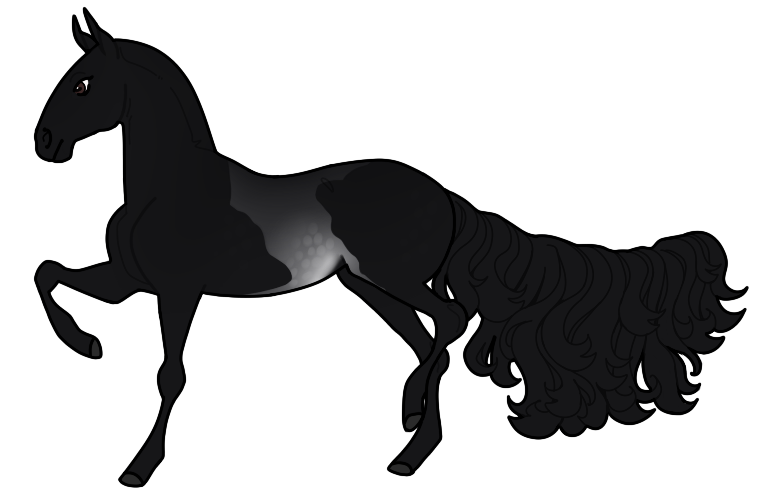
Black Rapunzel + Chimera (Grey on Black)

Latte Tobiano Splash Corset + Wulf, Halo, Chimera (Espresso Tobiano Splash)
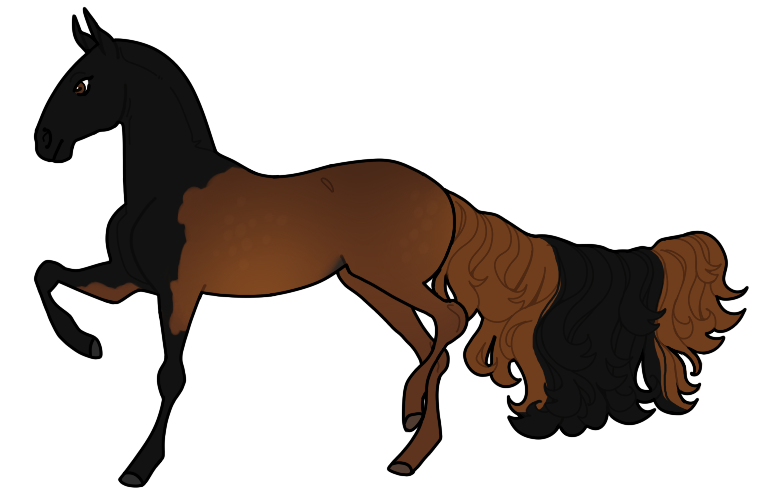
Chestnut Rapunzel + Chimera (Black)
107 results found.