Design Guide
Chestnut (Common)
Overview:
- Genetics: ee __
- Skin: Medium/Dark Grey
- Eyes: Brown | Detail Guide
- Body should be medium reddish-brown, relatively even across the coat.
- Mane and tail should match the body, or be slightly lighter or darker.
- Does not have dark points on the legs.
Variations:
- Liver Chestnut: Body becomes dark brown and less red/saturated. Mane/tail should be lighter than the body, often remaining a normal chestnut shade despite the darkening of the body.
Interactions:
- Dun: When Dun is added, the Phenotype is changed to "Red Dun" instead of "Chestnut Dun".
- Roan: When Roan is added, the Phenotype is changed to "Red Roan" instead of "Chestnut Roan".
- Flaxen: Chestnut and all dilutions (any coat with "ee" in the base) will be affected by Flaxen.
- Silver: Chestnut and all dilutions (any coat with "ee" in the base) will not be affected by Silver (listed as "Carries Silver").

Chestnut

Chestnut

Liver Chestnut
Bay (Common)
Overview:
- Genetics: E_ A_
- Skin: Dark Grey
- Eyes: Brown | Detail Guide
- Body should be brown or reddish-brown, relatively even across the coat.
- Mane and tail should be black. May have some slight brownish fading at the ends.
- Legs should be black to cover the knee/hock, blended where they meet the rest of the coat.
Variations:
- Seal Bay: Entire body should remain black except for the muzzle, eye, armpit, and groin/flank areas, which are brown. Legs should not have visible dark points, since the majority of the body will match them.
- Wild Bay: Black is restricted to the joints instead of the entire leg. Body should be medium to light bay rather than dark.
Interactions:
- Roan: When Roan is added, it tends to be fairly desaturated/greyish instead of lightening to tan.
- Sooty: Sooty applied to Bay coats can sometimes be black instead of just dark brown.
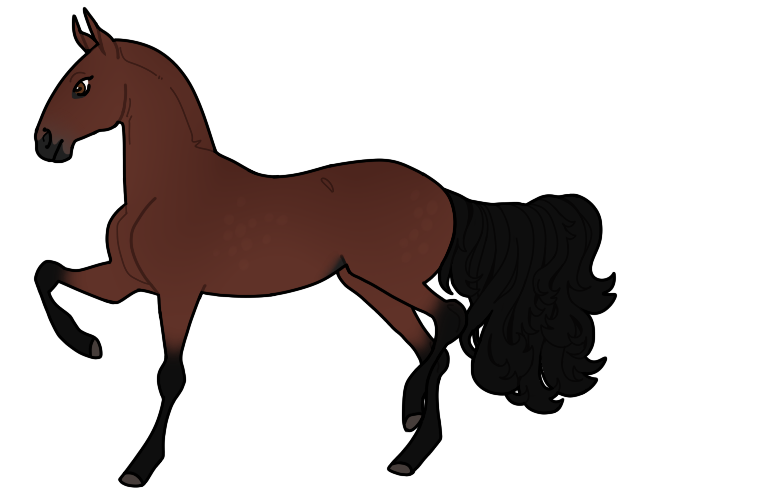
Bay
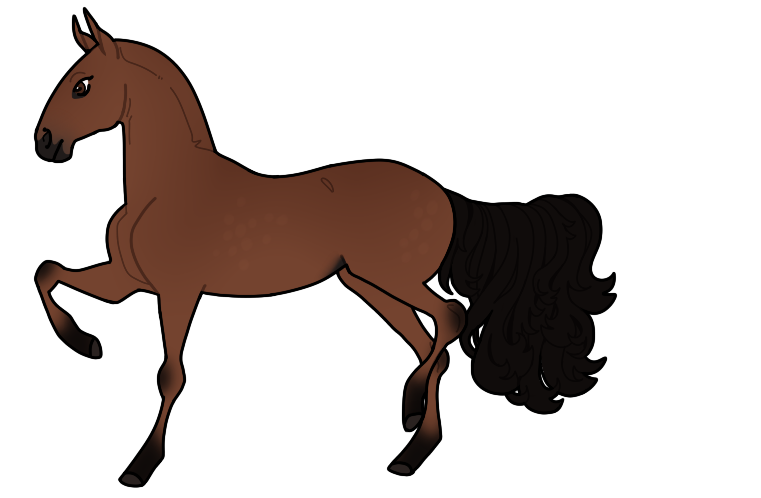
Wild Bay
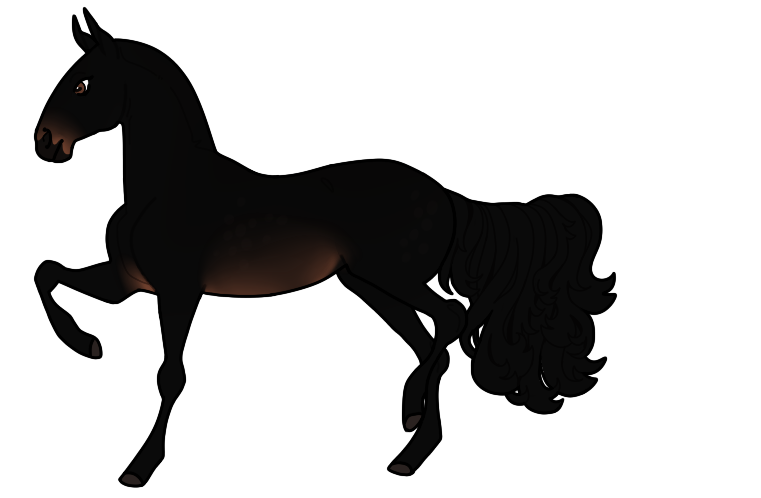
Seal Bay
Black (Common)
Overview:
- Genetics: E_ aa
- Skin: Dark Grey; matches coat when coat is non-faded
- Eyes: Brown | Detail Guide
- Comes in a variety of exact shades, but should overall read as "black" at a glance.
- Coat can be slightly brown/red or even blue/purple in hue, depending on shade and fading.
- Mane/tail should match the coat color. No visible dark points on the legs.
Variations:
- Faded Black: Black may fade into a lighter, browner, but still desaturated shade. Should not appear Chestnut or Bay. Mane/tail may also exhibit subtle fading at the ends.
Interactions:
- Dun: When Dun is added, the Phenotype is changed to "Grullo" instead of "Black Dun".
- Roan: When Roan is added, the Phenotype is changed to "Blue Roan" instead of "Black Roan".
- Silver: Black and all dilutions (any coat with "E_" in the base) will be affected by Silver.
- Flaxen: Black and all dilutions (any coat with "E_" in the base) will not be affected by Flaxen (listed as "Carries Flaxen").

Black

Faded Black

Black
Grey (Common)
Genetics: G_
Locus: G
Overview:
- Greys are born as their base color and will progress toward white throughout their lives.
- You may design your horse at any stage of grey as long as it meets the minimum.
- Body greying should originate from the neck/throat, groin, armpit, muzzle, and eye areas and spread from there.
- Mane/Tail: Gradually lightens with the coat over the horse's lifespan; lightest at the ends.
- Skin: No effect
- Eyes: No effect
Variations:
- Fleabitten Grey: Body is lightened to white or near-white, with small "fleabite" spots dispersed across the entire body. Fleabites should be the base color, and should be present across the entirety of the coat, except where covered by white markings.
- Bloodmarked: Can be added to any form or stage of grey. Bloodmarks are patches of color unaffected by grey, most often seen on Fleabitten Grey as an area of concentrated fleabites. These patches will show the base color beneath with no lightening. Edges should be textured.
Interactions:
- Rift: Will gradually desaturate Rift throughout the lifespan, but does not always cause it to lighten/grey out.
Range:
- Minimum: Must express obvious lightening in at least 2 of these areas: neck, groin, armpit, face (muzzle/eyes).
- Maximum: Body, mane, and tail are completely white; skin and hooves will remain consistent throughout lifespan.
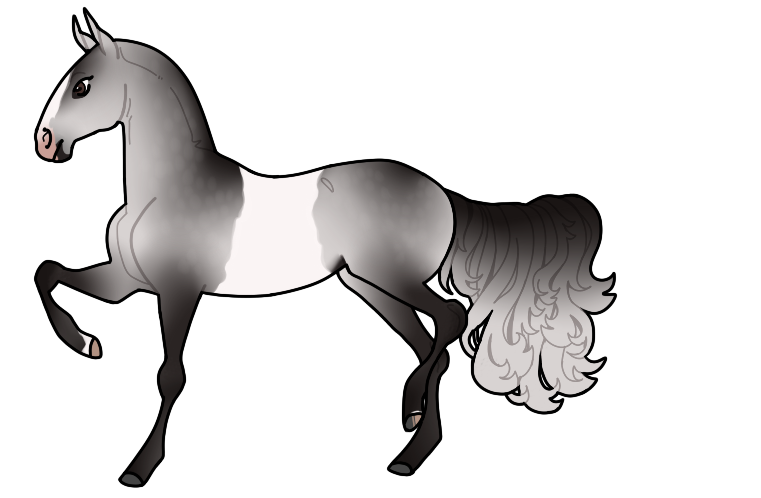 Grey on Black Corset
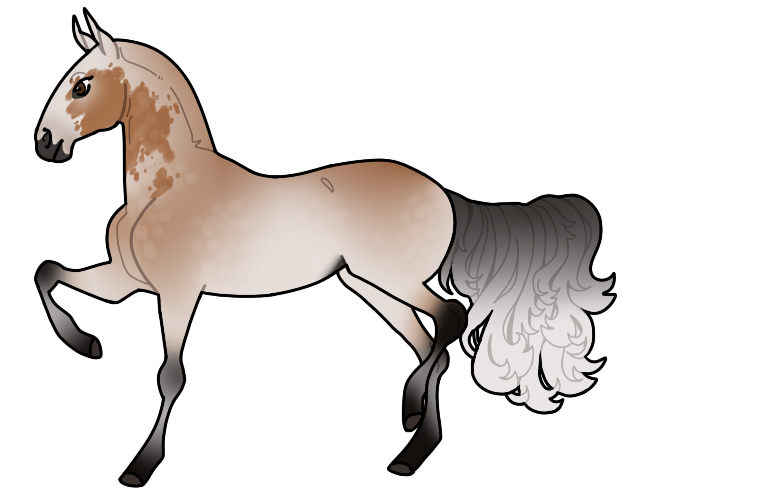 Grey on Buckskin (with Bloodmark)
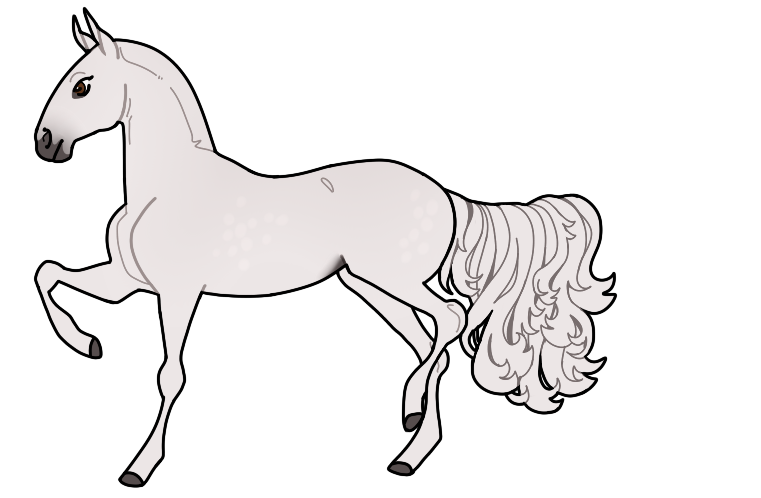 Grey on Chestnut
Flaxen (Common)
Genetics: f_*
* Must be homozygous and on an ee base to show; otherwise carried
Locus: f
Overview:
- Lightens the mane/tail to white or a significantly lightened, desaturated version of the normal color.
- Color is consistent throughout the mane/tail.

Flaxen Red Dun

Flaxen Raspberry Splash

Flaxen Chestnut
Silver (Common)
Genetics: Z_*
* Must be on an E_ base to show; otherwise carried)
Locus: Z
Overview:
- Lightens the mane/tail to grey/greyish-cream or white.
- May have roots matching (or slightly lighter than) original color, or be solid-colored.
- Dark roots should only cover the top third of the tail at most.

Silver Bay

Silver Blue Roan

Silver Amber Champagne
Sooty (Common)
Genetics: Sty_
Locus: Sty
Overview:
- Causes blended darkening of the coat, starting from the topline/back.
- May be somewhat isolated to an area but should still be blended out and not overly restricted.
- Should be a darker shade of the color underneath the area, often somewhat desaturated.
- Mane/Tail: May exhibit some darkening at the roots if sooty is in that area.
- Skin: No effect
- Eyes: No effect
Interactions:
- Dun/Roan: May darken the presentation of Dun/Roan but will not fully mask them; lightening/dilution must still be present.
- Black: Does not show on undiluted black (will be Carried on Black, Smoky Black, Blue Roan, etc).
- Bay/Buckskin: On Bay and Buckskin, Sooty may be black rather than just dark.
Range:
- Minimum: May be hidden.
- Maximum: May cover most of the body, leaving the undersides/"soft spots" alone.
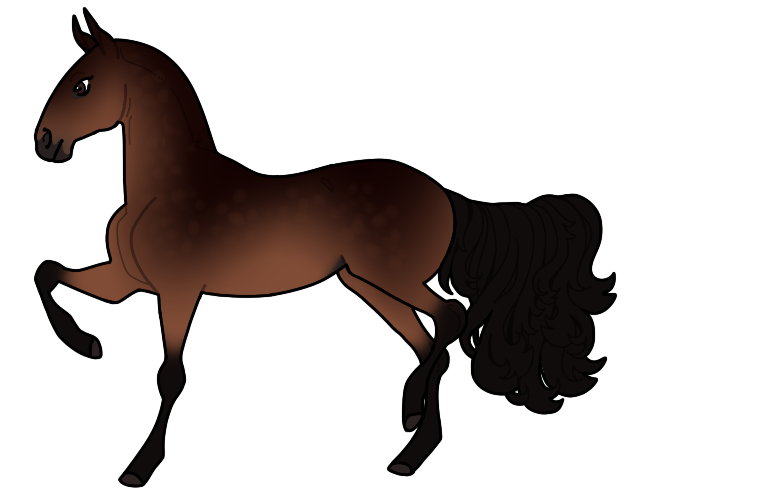
Sooty Bay

Sooty Classic Champagne

Sooty Gold Pearl
Pangare (Common)
Genetics: P_
Locus: Hk | P
HkP = Husky, nP/PP = Pangare
Overview:
- Causes blended lightening of the coat, starting from the facial regions and belly.
- Pangare should be noticeably lighter than the base color, sometimes cream or near white.
- Should not be a stark line, must be blended out.
- Mane/Tail: No effect
- Skin: No effect
- Eyes: No effect
Interactions:
- Dun: May lighten the presentation of Dun but not fully mask the primitive markings.
- Black: Does not show on undiluted black (will be Carried on Black, Smoky Black, Blue Roan, etc).
- Black Pigment: Will not lighten black pigment (such as Buckskin leg points, etc).
Range:
- Minimum: Visible lightening at the eyes, muzzle, and groin/belly.
- Maximum: Visible lightening at the eyes and muzzle, and following the curve of each body section (last example below). Should not reach topline.

Pangare Chestnut
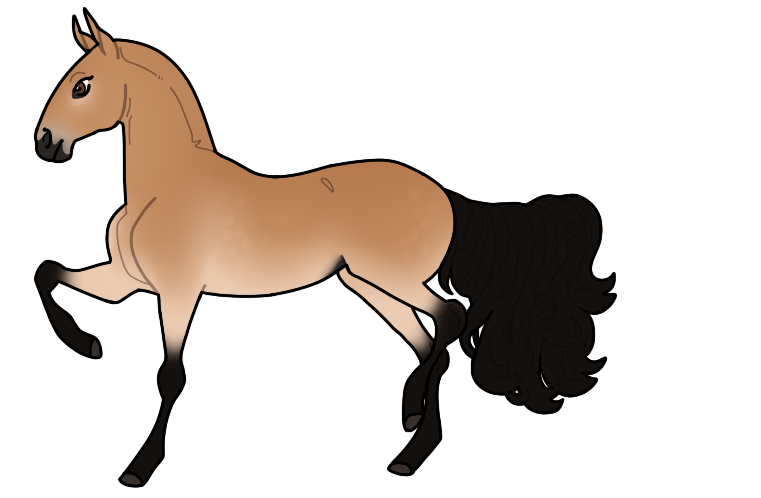
Pangare Buckskin

Pangare Chocolate Palomino
Snowfall (Common)
Genetics: Sf_
Locus: Sf
Overview:
- Causes speckling as if snow has collected on the topline and/or around white markings. You may choose one or both when designing!
- Topline: Concentrated on the withers/back, as if snow has been sprinkled on the horse.
- Marking: Concentrated on the border of the markings, and sprinkled slightly outward.
- Spots can vary in density and size, but should be smaller than the eye. Bigger patches are caused by dense spotting that merges.
- Spots should become sparser the further they are from the main concentration area, so that there is noticeable taper in density.
Range:
- Minimum: Must cover the withers or attach to at least one white marking - it cannot be completely hidden.
- Maximum: Snowfall along the topline and all markings. Topline concentration should only cover about 1/4 of the barrel vertically.
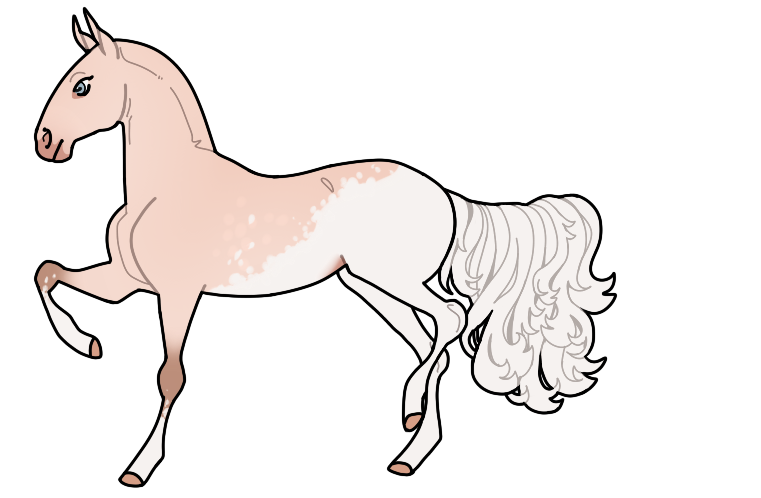
Perlino Splash Snowfall
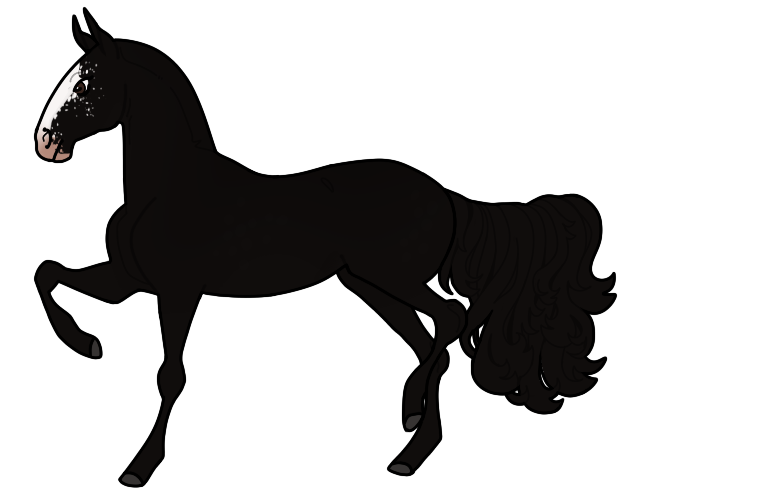
Black Snowfall
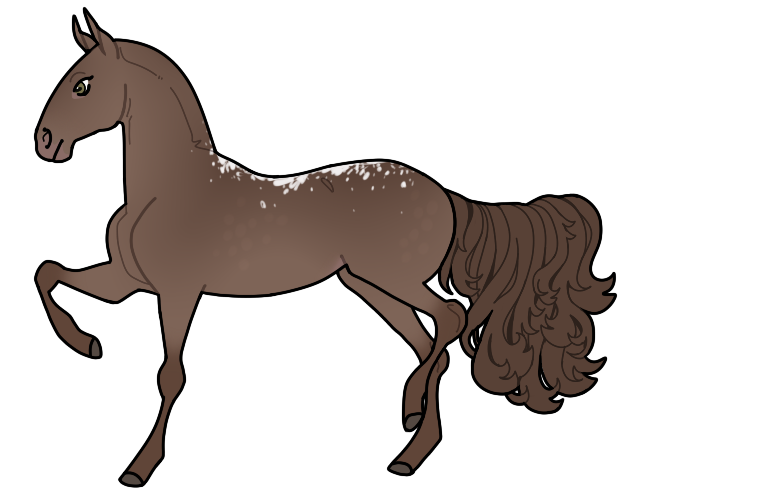
Black Pearl Snowfall
Corset (Common)
Genetics: Co_
Locus: Co
Overview:
- Causes a white band around the barrel.
- Should not be perfectly smooth; edges should have some degree of variance.
- Thickness can vary slightly, but should be fairly consistent from top to bottom.
- Must begin at some point on the first 1/3 of the back (measured from start of withers to point of hip).
- Cannot start further up than the start of the withers, nor end further back than the hip.
- Mane/Tail: No effect
- Skin: Pink where covering
- Eyes: No effect
Range:
- Minimum: Should be at least as wide as the withers.
- Maximum: May cover the entire barrel from withers to hip.
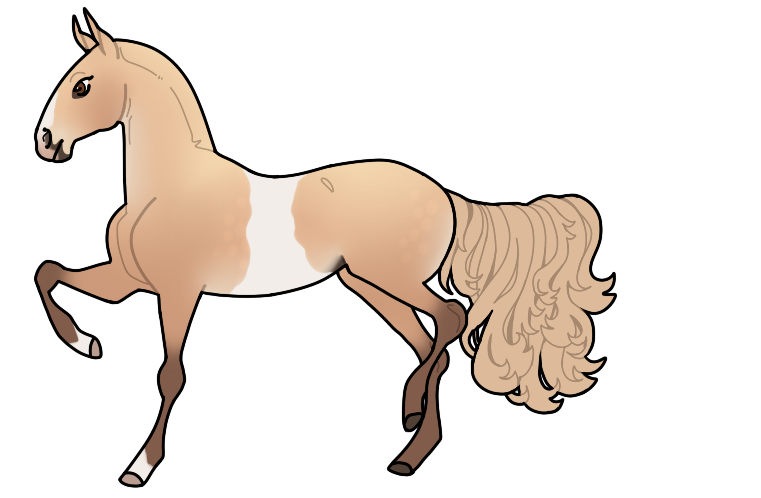
Almond Corset
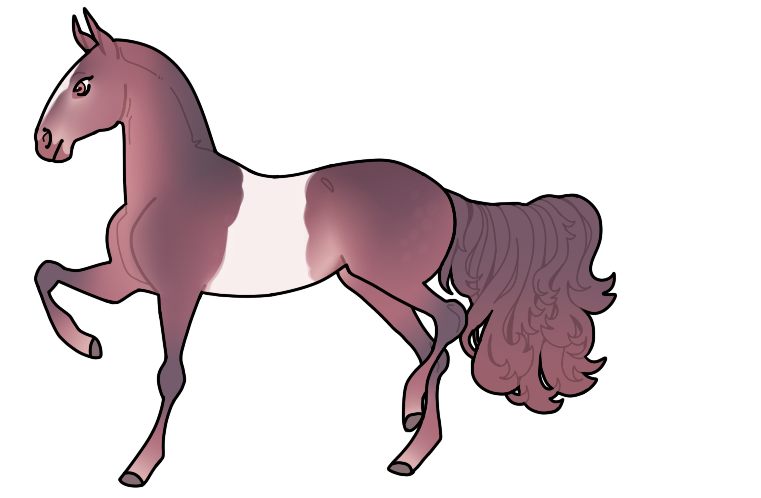
Pangare Sakura Corset Orchid
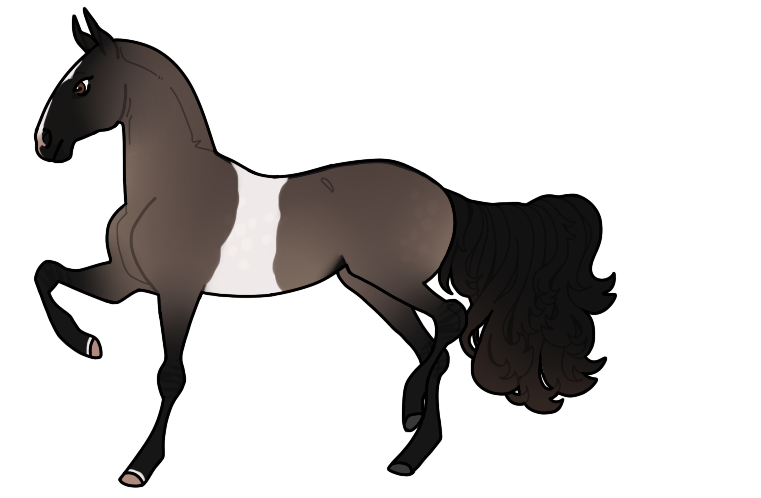
Grullo Corset
Stained (Common)
Genetics: St_
Locus: St
Overview:
- Stained may present in two different forms. You may freely choose either form when designing, but not both.
- Causes parts of the coat to be darkened - area/amount is dependent on the version chosen.
- Darkening should be medium/low-opacity, keeping underlying variance intact (dapples, countershading, etc).
- May exhibit darker or lighter mapping around the stained markings.
- Version A:
- Causes 1-3 random independent patches of the coat to be darker.
- Patches should have edges with cutouts, similar to the shape/edges of Overo.
- Version B:
- Darkens some or all of the white markings on the horse. Adheres to all rules/bounds for the marking, just makes them dark.
- If a marking is darkened, it must affect all white that physically touches it, even if caused by two different genes.
- Natural white may be applied on top after staining if desired (this is the only exception to the "all white that touches" rule above).
- Affects everything listed under "White Markings" on the Visual Hierarchy page.
- Mane/Tail: Version A does not affect the mane/tail. Version B does affect the mane/tail wherever it would usually be white.
Interactions:
- Halo: Mapping on Version B can be affected by Halo, darkening the Halo as well if the main marking is Stained.
Range:
- Minimum:
- Version A: At least one marking as large as the head.
- Version B: At least one marking affected.
- Maximum:
- Version A: Up to three different markings, not exceeding more than 1/3 of the body total on each side.
- Version B: All white markings are affected.
Version A Examples:
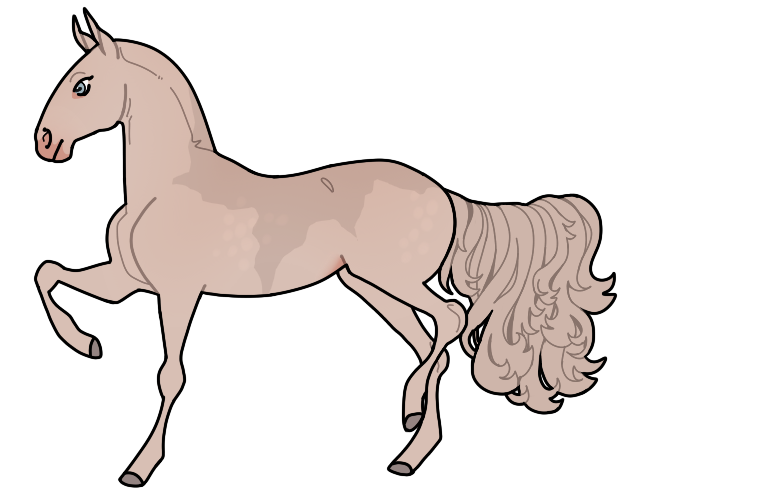
Stained Smoky Cream
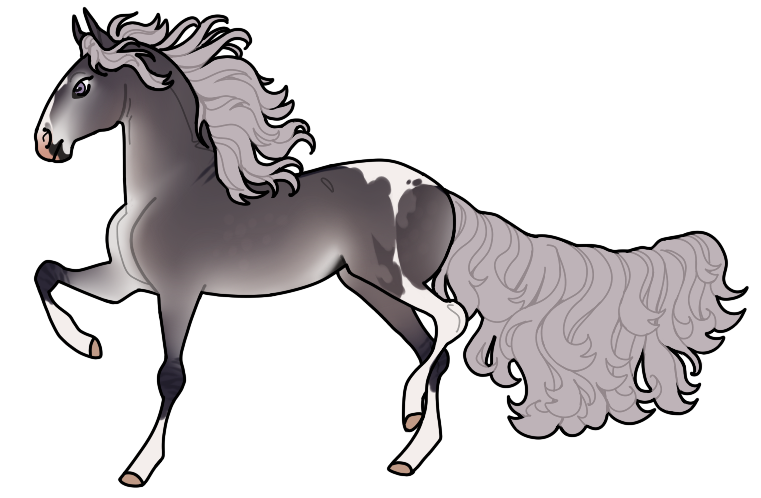
Stained Silver Abyss Husky Dun Tobiano Rapunzel + Wulf
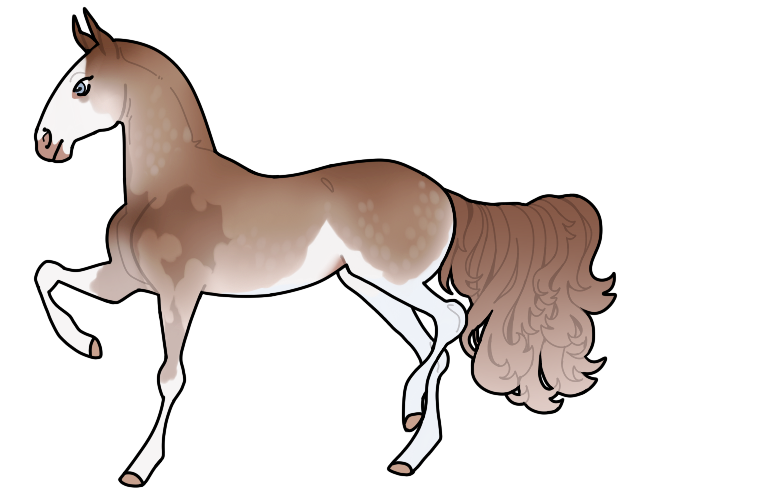
Stained Grey on Chestnut Splash
Version B Examples:
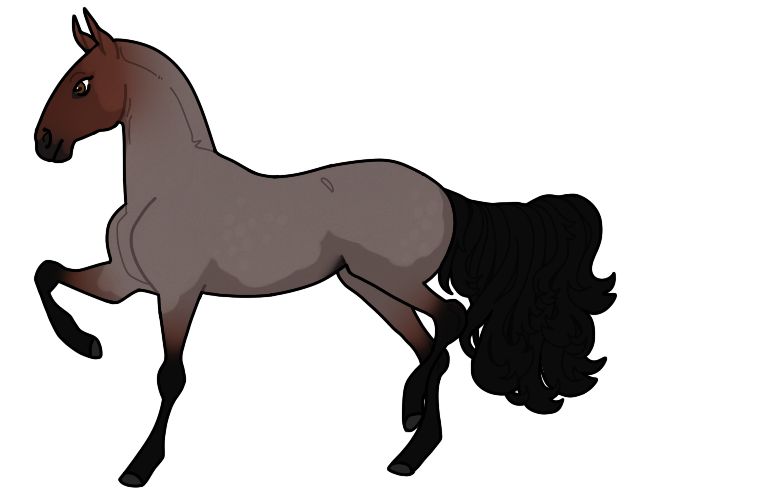
Stained Bay Roan Splash
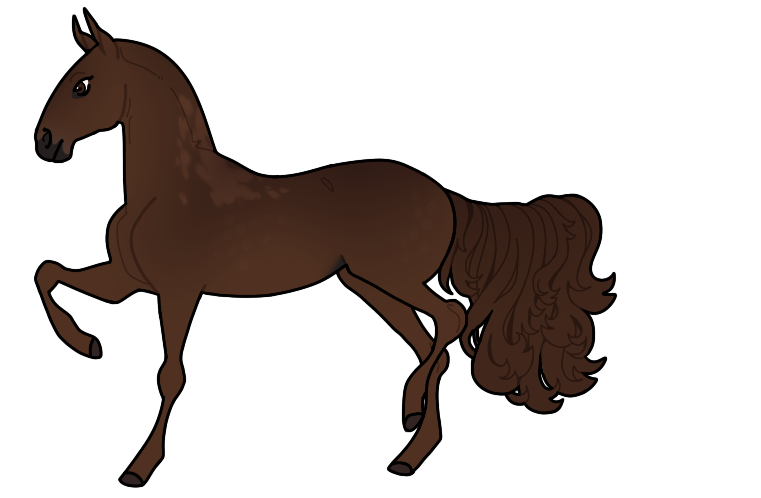
Stained Dominant White on Liver Chestnut
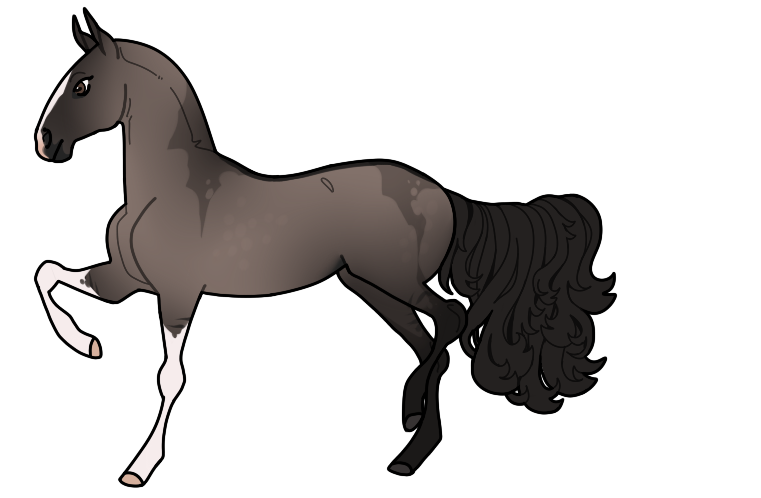
Stained Grullo Tobiano
Blotted (Common)
Genetics: Bl_
Locus: Bl
Overview:
- Creates numerous holes in white patterns.
- Holes can vary in distribution/amount but should be somewhat oval in shape.
- Size of the holes should generally mirror Appaloosa spots, but can be a bit smaller (should not resemble fleabites).
- Can affect some or all white markings on the body, including natural white (face/leg markings).
- Affects everything listed under "White Markings" on the Visual Hierarchy page.
Range:
- Minimum: May be fully hidden.
- Maximum: May affect all white markings on the body. Must be clearly identifiable as spots/holes, not large patches.
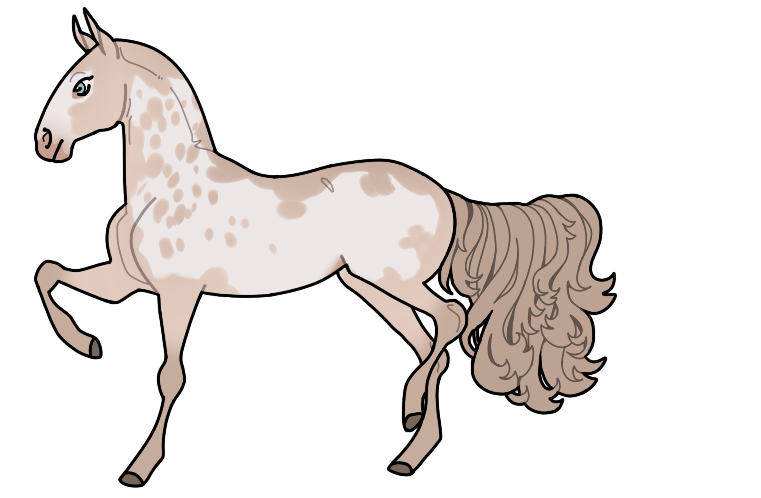
Blotted Smoky Cream Overo
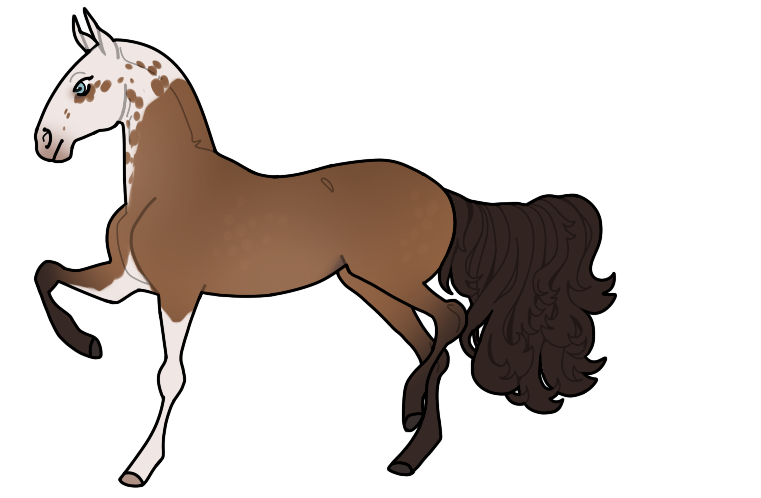
Blotted Bay Pearl Splash
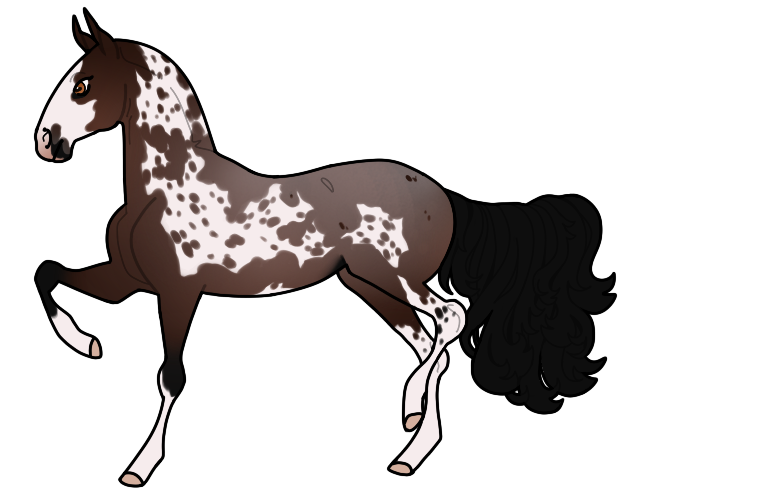
Blotted Bay Roan Overo
Primitive Dun (Common)
Genetics: Dt_
Locus: B | Ty | Cv | Dt | D
CvDt = Civet, TyDt = Tabby, BDt = Bengal, DtD = Primitive Dun, nDt/DtDt = Primitive Dun
Overview:
- Dilutes the body, leaving the legs and head alone (may reach the cheek slightly).
- A modified form of Dun. Causes an exaggerated expression of primitive markings.
- Leg barring and dorsal stripe are required, while shoulder barring and facial cobwebbing are optional.
- Will extend, thicken, and overall exaggerate the stripes in these areas.
- Stripes must clearly radiate from normal dun markings, and should taper at the edges.
- Stripes on the front half of the body should be vertical, may not cross the throat/underside of the neck, and should stop just after the withers.
- Stripes on the back half of the body should be horizontal, stop at the dock of the tail (not continue on to the back), and should not pass the hip.
- Stripes on the front legs will gradually transition to become more vertical as they meet the markings coming from the topline.
- Primitive markings should be a few shades darker than the points, or black if points are already black.
- Mane/Tail: May exhibit light "frosting" blended at the roots of the hair.
- Skin: No effect
- Eyes: No effect
Interactions:
- Civet, Bengal, and Tabby: When paired with these genes, Primitive Dun will be hidden and have no effect.
- On renamed Dun combos, "Primitive" will be written before the color rather than after (Primitive Grullo, Primitive Red Dun, Primitive Dunalino, etc).
Range:
- Minimum: Dilution (lightening) of the body, as well as leg barring and dorsal stripe. May look like normal Dun at minimum.
- Maximum: Extension of all primitive markings (leg barring, shoulder barring, facial cobwebbing) to the bounds described above.
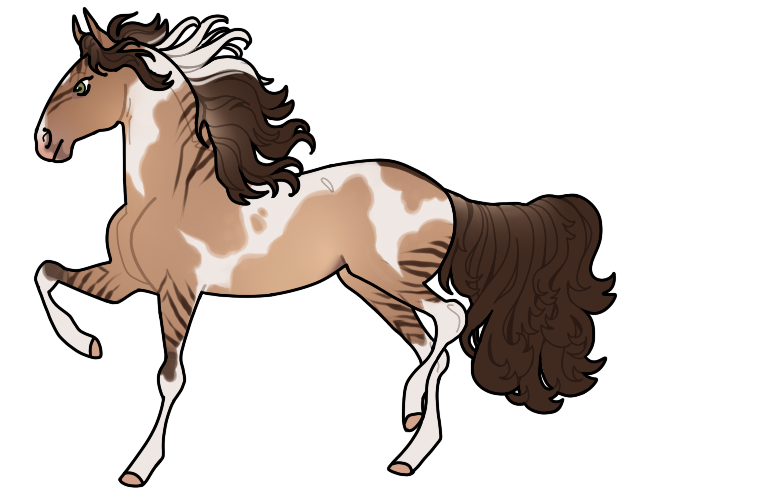
Bay Pearl Primitive Dun Tobiano + Wulf
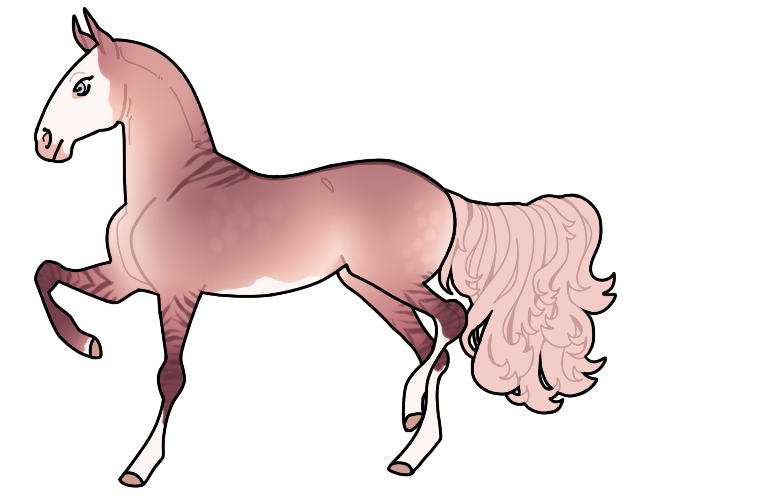
Dawn Primitive Dun Splash
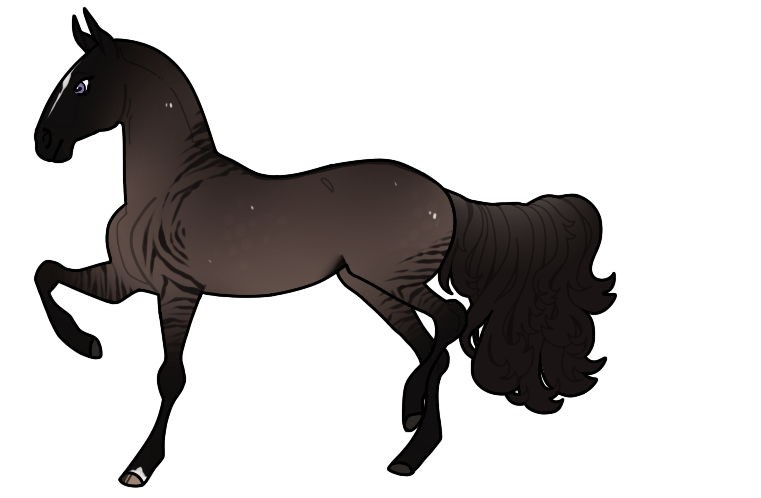
Primitive Grullo + Birdcatcher spots
Cowspot (Common)
Genetics: Cw_
Locus: Cw | Rm | R
CwRm = Cowspot, CwR = Cowspot Roan, nCw/CwCw = Cowspot
Overview:
- Inspired by cattle coat patterns, particularly Texas Longhorns, Dairy Shorthorns, White Park, etc.
- Causes a white marking on the body of the horse, with rounded patches of the base color showing through.
- The majority of the patches should be at least as large as the hoof, but often cluster together to make larger patches.
- Edges of the white marking should have patches "cutting in" to them rather than being a smooth edge.
- The white marking should be densely speckled with spots of the base color, similar to Flecked or fleabitten grey.
- Mane/Tail:
- Mane white where white touches
- Tail solid colored, solid white, or partial white that covers up to 3/4 of the tail
- Skin: Pink where covering.
- Eyes: No effect
Interactions:
- May interact with Patchwork, Inverse, Blotted, Halo, and Stained.
Range:
- Minimum: White marking should cover at least from the withers back, with at least a few patches.
- Maximum: White marking may cover everything except the muzzle, eyes, ears, and pasterns/coronets.

Bay Plum Cowspot

Gold Champagne Cowspot Roan + Wulf, Halo

Blueberry Cowspot
Cordillera (Common)
Genetics: Cd_
Locus: Cd
Overview:
- The mutation was named for its likeness to mountain ranges.
- Edges will not be overly jagged, contain holes, or double back, and should overall suggest the shape of a natural mountain range.
- Peaks should not exceed roughly 2/3 of the barrel in height, nor be so small as to be undiscernible as peaks.
- Peaks should vary in height and width, not be the same all the way across. Should have angles at the peaks and valleys, not be rounded.
- Leg markings should end somewhere between the stomach line and the top of the knee/hock.
- When paired with Halo, this can cause the illusion of two layers of peaks.
- Mane/Tail: No effect
- Skin: Pink where covering.
- Eyes: No effect
Interactions:
- May interact with Patchwork, Inverse, Blotted, Halo, and Stained.
Range:
- Minimum: White must extend from the buttock to the armpit, or from the chest to the groin.
- Maximum: Marking may cover from chest to butt, not exceeding roughly 2/3 of the barrel in height.

Chestnut Cordillera
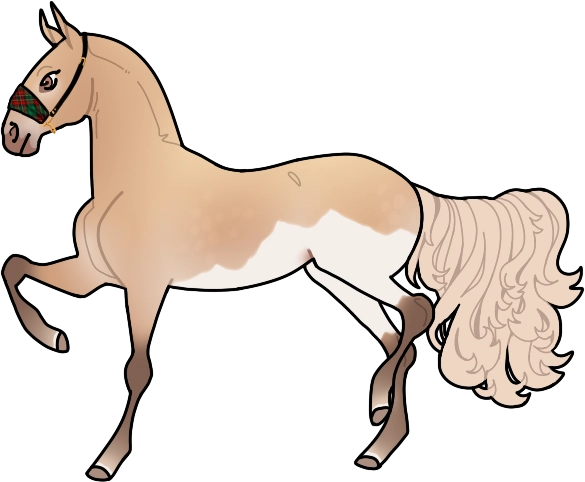
Pangare Almond Orchid Cordillera
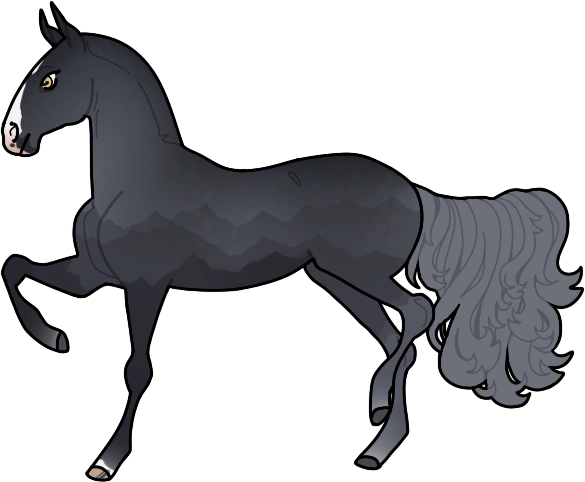
Stained Sooty Slate Cordillera + Halo, Chimera (Sooty Slate)
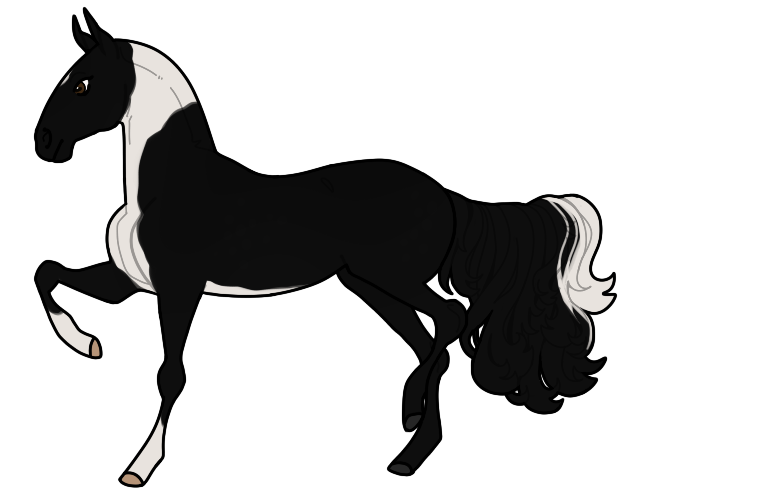
Tuxedo (Common)
Genetics: Tx_
Locus: Tx
Overview:
- A single unbroken white marking that follows the underside of the horse's neck and chest.
- Also causes a "collar" within the top half of the neck; must be at least as wide as the hoof.
- Markings should be relatively smooth, with subtle variance - not jagged or abrupt.
- Should not reach the head or legs.
- Note: Tuxedo is not always visible in the chest area when viewed from the side. As long as it is clearly visible on the neck and the marking is unbroken when drawn at an angle that shows the chest, you're good to go! Click here for an example.
- Mane/Tail:
- Mane is always white where touching.
- Tail optionally may have white at the end, covering up to 1/4.
- Skin: Pink where covering
- Eyes: No effect
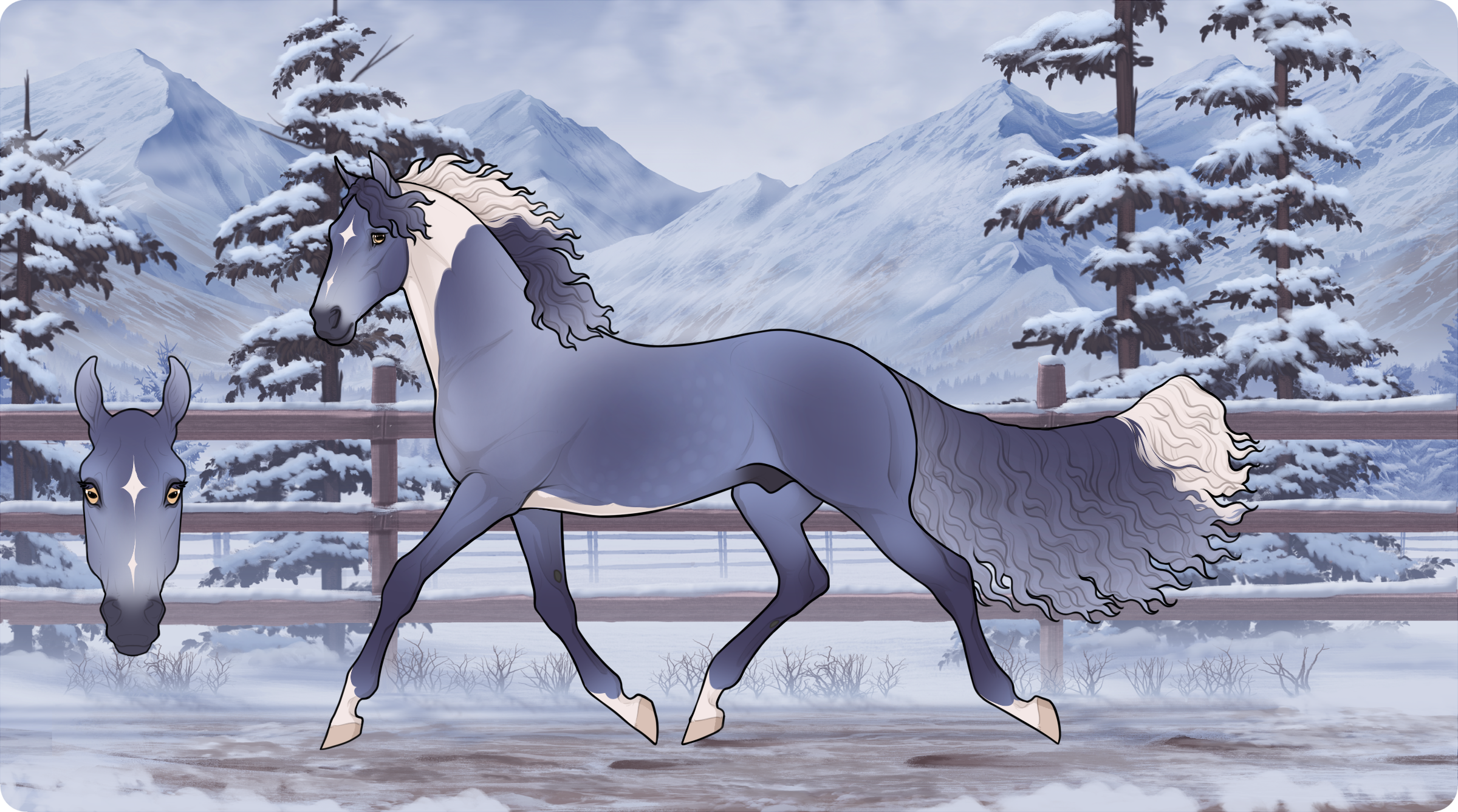
Range:
- Minimum:
- White from the throatlatch to the space between the front legs (end of chest/start of belly), wide enough to be clearly visible.
- Collar on the upper half of the neck that is at least as wide as the hoof.
- Maximum:
- White from the throatlatch to about 3/4 down the belly, stopping before reaching the groin.
- Collar covers the entire upper half of the neck.
 Perlino Tuxedo
 Black Tuxedo
 Pangare Sakura Tuxedo Rapunzel
Birdcatcher Spots (Common)
Overview:
- Presents as small white spots dispersed around the body.
- Should be small and sparse, not to exceed approximately the size of the pupil.
- Mane/Tail: No effect
- Skin: No effect
- Eyes: No effect

Primitive Smoky Grullo + Gemstone, Birdcatcher Spots

Sooty Primitive Grullo Tuxedo + Wulf, Gemstone, Birdcatcher Spots
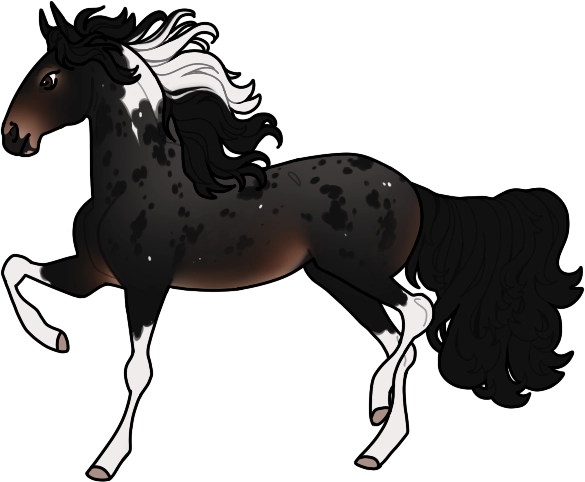
Pangare Seal Bay Merle Roan Tobiano + Wulf, Birdcatcher Spots
Grease Spots (Common)
Overview:
- Creates dark spots dispersed throughout the coat, roughly the size of the eye or smaller.
- Should be a few shades darker than the coat beneath.
- Mane/Tail: No effect
- Skin: No effect
- Eyes: No effect

Bay Roan + Grease Spots
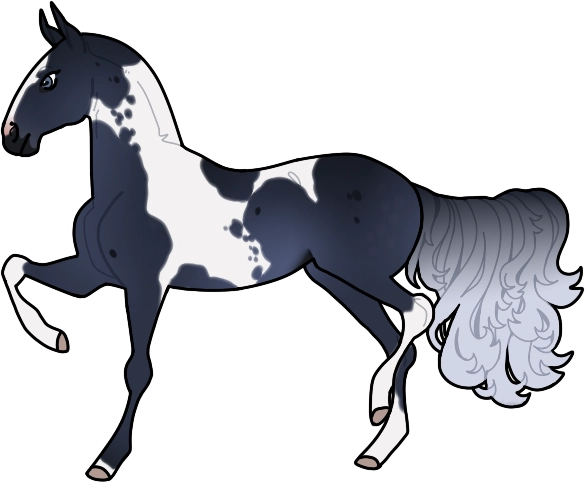
Silver Blueberry Tobiano + Grease Spots
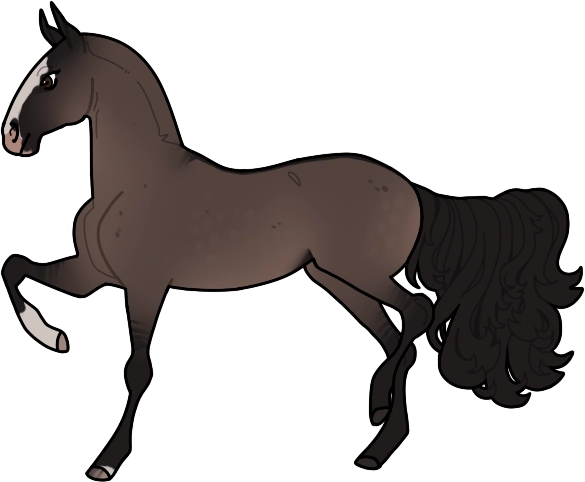
Grullo + Grease Spots
Flecked (Common)
Overview:
- Causes small, dark freckle-like spots to cluster along the curves of the body.
- Spots should be a few shades darker than the coat beneath, but not overly dark.
- Requires spots to be individually distinct (no patches), same opacity, and have a clear area of concentration.
- Should not be strewn randomly across the body, perfectly evenly spaced, all exactly the same size, or extremely sparse.
- Flecked should be most dense along the curve, and have some stray spots spreading from there to create a density gradient.
- Clusters should create an elongated curved shape, not a circle, swirl, or other design.
- Mane/Tail: No effect
- Skin: No effect
- Eyes: No effect
Acceptable Range/Areas:
- Chart below shows acceptable areas of effect.
- The lines drawn are intended to give a vague idea of the flow/shape, but are not precise limits.
- Clusters should not be in other areas (i.e. legs), but can vary a bit within the areas given.

Range:
- Minimum:
- One small cluster of spots in any acceptable area.
- There should be enough spots to clearly indicate a clustered area of effect, not just one or two random spots.
- Maximum:
- One cluster of spots on the head and two clusters of spots on the body.
- Body clusters may join two areas together if adjacent, but shouldn't branch across the whole body.
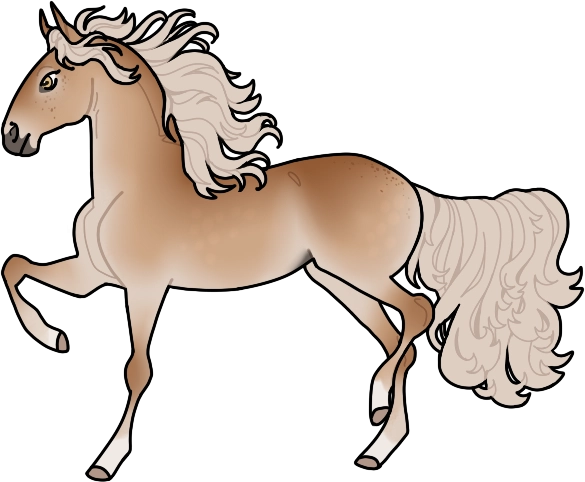
Flaxen Pangare Flame + Wulf, Flecked
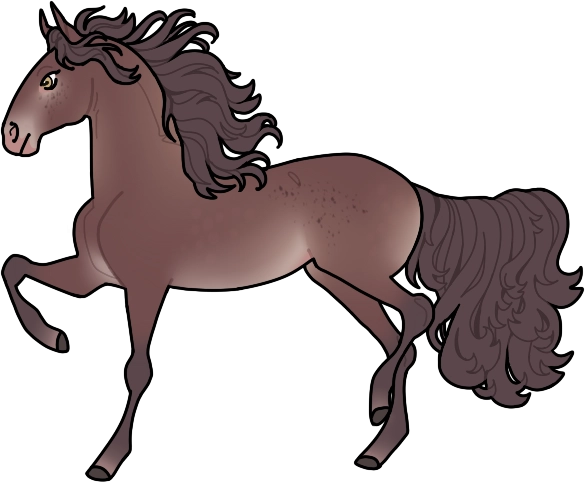
Pangare Amber Champagne Plum + Flecked, Wulf
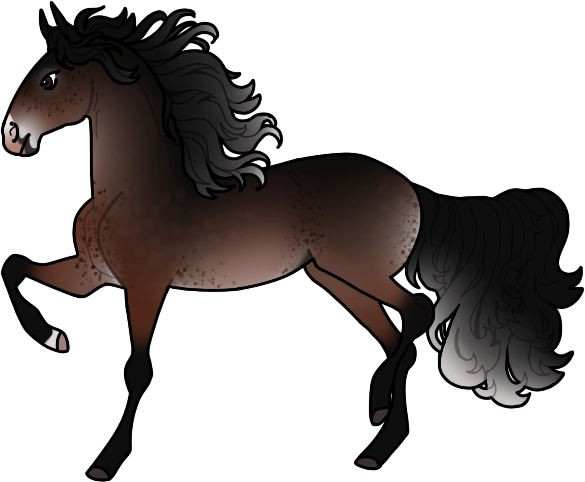
Grey on Sooty Bay + Flecked, Wulf
Halo (Common)
Overview:
- Causes markings to partially "fail," producing an extended mapping effect (low-opacity white around the marking).
- Mapping should represent a correct placement of the marking, but with solid white not fully coming out to the edges.
- Halo may affect some or all of the markings, including natural white, but should still leave a significant amount of solid white in each area (i.e. no areas that are fully just low-opacity / mapping).
- Mane/Tail: No effect
- Skin: No effect
- Eyes: No effect
Interactions:
- Halo interacts with Patchwork to cause low-opacity mapping that shows the Patchwork coat rather than being low-opacity white.
- When paired with Marbled, all Halo mapping will become dark instead of low-opacity.

Sooty Bay Roan Tobiano + Halo, Grease Spots
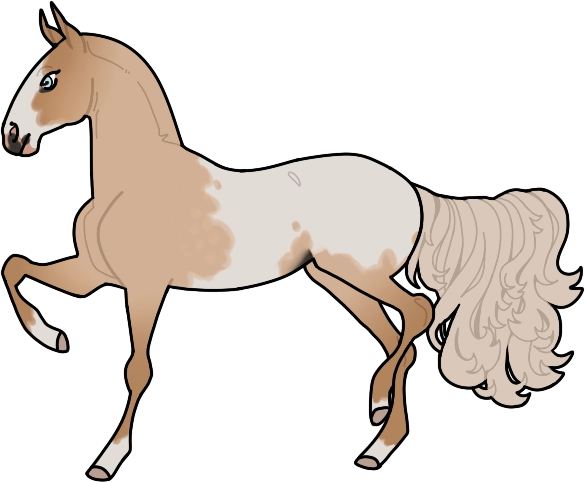
Palomino Roan Overo Snowcap + Halo
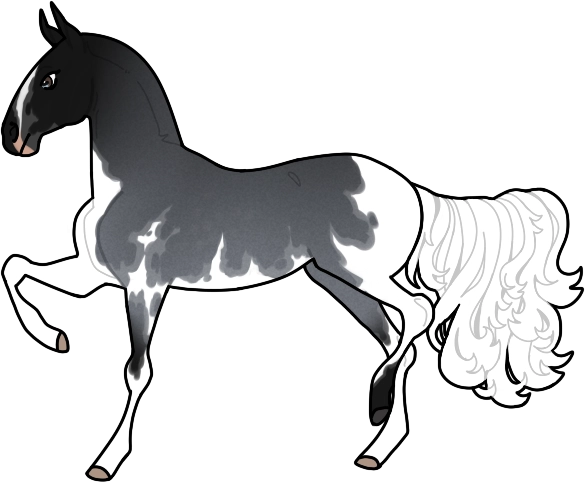
Blue Roan Sabino Splash + Halo